Developing Playfulness
Why Play Matters in Horsemanship: Growing Partnership Through Creativity
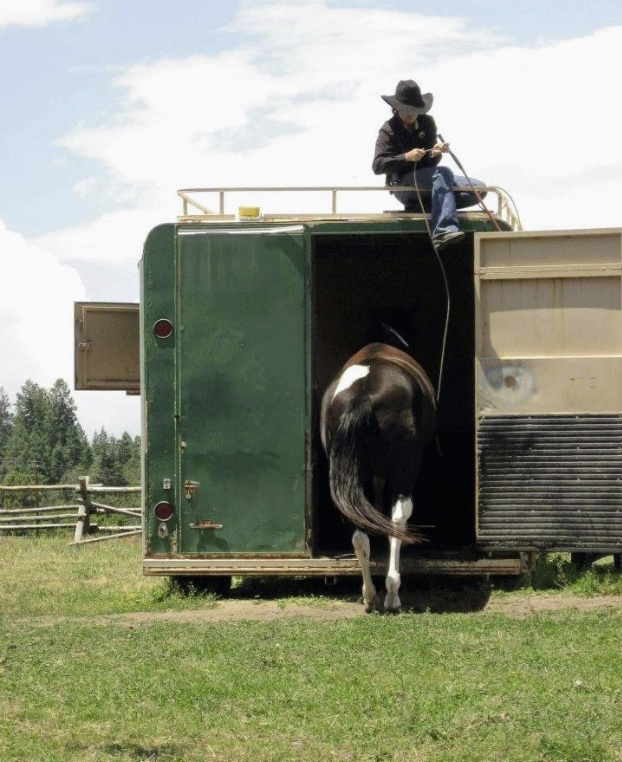
Kristi loading her horse Maxi into a trailer (while sitting on the roof)!
As our horsemanship deepens, it’s easy to become overly focused on correctness, precision, and progress markers. Goals matter. Skill matters. But partnership thrives on something often overlooked as we “get more serious”: play.
Play is not a lack of discipline. It is a state of curiosity, presence, and mutual engagement. Horses learn best when their nervous systems are regulated and their minds are available. Playfulness keeps the conversation alive. It softens rigidity, invites expression, and creates space for learning to feel good for both horse and human.
When we intentionally bring creativity into our work with horses, we shift from training at them to exploring with them.
Obstacle Courses as Creative Conversation
Designing and navigating obstacle courses encourages both planning and adaptability. When riders build their own courses—using poles, cones, natural features, or everyday objects—they engage the thinking side of horsemanship before ever asking the horse to participate.
For the horse, obstacles become puzzles rather than tests. For the human, they offer feedback: How clearly did I communicate? How relaxed was my body? Did I stay curious when things didn’t go as planned? Creativity here builds confidence and responsiveness without pressure.
Imaginary Scenarios and Mental Flexibility
Imaginary scenarios may sound frivolous, but they develop an essential skill: flexible thinking. Pretending you’re navigating a trail challenge, a cattle drive, or a long fictional journey reframes common exercises with fresh intention.
Horses respond to intention more than people realize. When your focus shifts from “getting it right” to “figuring it out together,” your energy changes—and horses notice. These mental games help riders stay engaged, inventive, and emotionally present.
Artistic Expression and Seeing Differently
Art activities like drawing, journaling, or simple crafting connected to horsemanship tap into observation and reflection. Sketching your horse’s posture, drawing an arena pattern, or visually mapping an exercise helps translate feel into understanding.
Art slows us down. It invites us to notice details we might otherwise rush past. That awareness carries directly into how we handle, ride, and relate to our horses.
Storytelling and Shared Meaning
Storytelling sessions—whether written or spoken—allow riders to reflect on experiences and give them meaning. Sharing stories about breakthroughs, challenges, or funny moments normalizes the learning process and builds community.
For the individual horse-human partnership, storytelling reinforces that the relationship is evolving. It’s not a checklist. It’s a narrative, shaped by shared experiences and mutual growth.
Role-Playing for Problem Solving
Role-playing different horsemanship scenarios encourages empathy and adaptability. Switching roles—imagining what the horse might be processing, or how a different handler might approach the same situation—expands perspective.
This kind of creative problem-solving reduces frustration. Instead of asking, “Why won’t my horse do this?” the question becomes, “What might help us understand each other better?”
Creative Riding Patterns and Freedom Within Structure
Unconventional riding patterns—curves, spirals, figure-eights, asymmetrical shapes—invite fluidity and awareness. They keep both horse and rider mentally engaged and physically balanced.
Creativity in patterns doesn’t replace fundamentals; it reveals them. Straightness, rhythm, and responsiveness become easier to feel when the work stays interesting and varied.
Equine Bonding Games and Joyful Interaction
Games that emphasize connection rather than outcome strengthen trust. Liberty play, follow-the-leader exercises, and simple responsiveness games reward curiosity and willingness.
Joy is not a distraction from learning. It is often the condition that makes learning possible.
Music, Movement, and Rhythm
Pairing horsemanship with music can transform how riders experience timing, flow, and energy. Whether mounted or on the ground, moving with rhythm encourages softness and coordination.
Horses are inherently rhythmic animals. When humans tune into that, communication becomes smoother and more intuitive.
Nature-Inspired Activities and Environmental Awareness
Using natural elements—logs, hills, water, plants—grounds horsemanship in the real world. Nature-inspired obstacle courses and activities promote adaptability, confidence, and environmental awareness.
They also remind us that horses didn’t evolve in arenas. Bringing nature into our work supports both physical soundness and mental well-being.
Team Challenges and Shared Play
Collaborative challenges encourage creative thinking and community. Working together to solve problems builds perspective and reduces comparison. Horses benefit from calmer, more thoughtful humans, and humans benefit from shared insight and support.
Play as a Path to Partnership
Being playful with horses doesn’t mean being careless. It means staying curious, flexible, and emotionally available. Play keeps the relationship alive. It helps us notice when things feel good—and when they don’t.
Partnership grows when both horse and human have reasons to participate willingly. Creativity gives us more ways to listen, respond, and enjoy the process.
In the end, play isn’t something we outgrow as horse people. It’s something we return to—wiser, more skilled, and more attuned than before.
Horsemanship doesn’t have to be a lonely journey. If you’re looking for thoughtful coaching, meaningful conversation, and a community that values harmony over force, I’d love to welcome you.