Over the years, the details of how I train horses have changed, but the larger goals have remained surprisingly consistent.
I still want to develop the kind of communication that allows me to influence my horse from the end of a 45-foot line. I want to play at liberty in both small and large spaces. I want to develop enough harmony to ride bridleless, even if I never actually remove the bridle. And I want to be able to pick up my reins and gymnasticize my horse’s body in ways that support soundness and longevity.
Those are ambitious goals. They are not accomplished in a weekend, and they are too broad to tell me what I should do when I walk into the arena on an ordinary Tuesday morning. To make them useful, I need to break them into smaller, observable tasks. Those tasks give me something specific to shoot for and help me recognize progress before the finished result is there.
Training horses has repeatedly shown me that meaningful progress depends on three things: goals, strategies, and time. If one of the three is missing, the results tend to become inconsistent—and inconsistency is very easy to blame on the horse.
1. Goals Give Us Direction
A training goal should help us answer two questions: What are we working toward, and how will we know whether we are getting closer?
My larger goals are still similar to the ones I had during my years with Parelli Natural Horsemanship. What has evolved is my understanding of what must exist underneath those accomplishments. I no longer see a task only as something to perform successfully. I also see it as a way to measure whether my horse and I have developed the communication, emotional fitness, balance, and understanding that the task requires.
That is why I use a progressive series of tasks, moving from basic skills to moderate challenges and eventually to mastery. A task might ask us to work from farther away, maintain connection in a larger space, or perform a maneuver with greater precision. Each step makes the destination less overwhelming. It also gives me useful information. If we struggle, I do not have to label the entire session a failure. I can ask which ingredient is missing and return to a step where we can rebuild it.
These tasks are milestones. Once a task is trained and dependable, I can check it off my list and move on to the next goal. I may revisit it occasionally, but I do not need to keep treating it as the center of our training. Its purpose was to help us develop and measure a particular capability. Once that capability is established, the next task gives us a new place to grow.
My mares have taught me how important that is. Kaya’s progress, for example, has not come from repeatedly testing whether she can do the finished thing. It has come from building the pieces that allow the finished thing to emerge. Every small success has given us a platform for the next question. When we encounter a hole, the task helps me locate it. It does not tell me that she is a bad horse or that I am a bad trainer. It tells me what needs more preparation.
Goals give our training direction, but goals alone are not a training plan. Knowing what we want does not automatically tell us how to help the horse understand it.
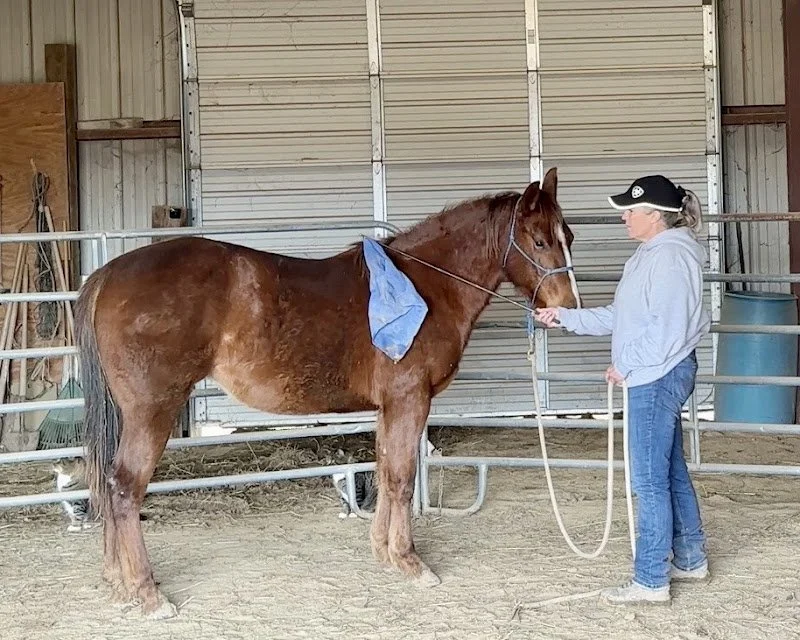
A very young Kaya
2. Strategies Help Us Solve the Puzzle
I use the How To Talk Horse program to develop a shared language with my horses and to improve my own ability to solve training puzzles. The program helps us develop connection, relaxation, responsiveness, confidence, impulsion, bending, harmony, agility, purpose, and power.
Initially, the techniques within each module are training goals themselves. I may be teaching a particular yield, pattern, or exercise designed to improve relaxation or responsiveness. In the beginning, I am simply trying to help my horse understand and perform that skill.
Once the skill is learned, its role changes. It becomes a strategy. Unlike a task that I can check off and move beyond, a strategy stays in my toolbox. I keep it because I will need it again. As our goals become more difficult, it is completely normal for connection, relaxation, responsiveness, or confidence to weaken. The trained strategy gives me a familiar way to recover the missing quality and then continue toward the goal.
If I increase the difficulty of a task and lose connection, I can use a familiar connection strategy to restore it. If my horse becomes tense, I have trained ways to help her find relaxation again. If her responses become dull or hurried, I have tools for rebuilding responsiveness without simply becoming louder. If her confidence disappears when we enter a new environment or attempt something more demanding, I can address the confidence problem instead of repeatedly drilling the task that exposed it.
This distinction between tasks and strategies matters. Tasks help us measure progress and give us milestones we can complete. Strategies become reusable skills that support us through many different tasks and real-world situations. Without strategies, we tend to keep asking for the goal with more pressure, more repetition, or more determination. We may know what we want, but we do not have enough ways to help the horse get there. A trained strategy gives us another question to ask instead of merely asking the same question louder.
Working with different mares has made that lesson impossible for me to ignore. The same task can reveal very different needs. One mare may lose relaxation, another may lose forward responsiveness, and another may remain obedient while quietly disconnecting. The visible problem might look similar, but the solution is not necessarily the same. The How To Talk Horse strategies give me a way to identify which quality has gone missing and respond to the horse in front of me.
The goal is not to collect techniques. It is to become more skillful at recognizing what is happening and choosing a useful response. That is how our relationship deepens and how we become better puzzle solvers.
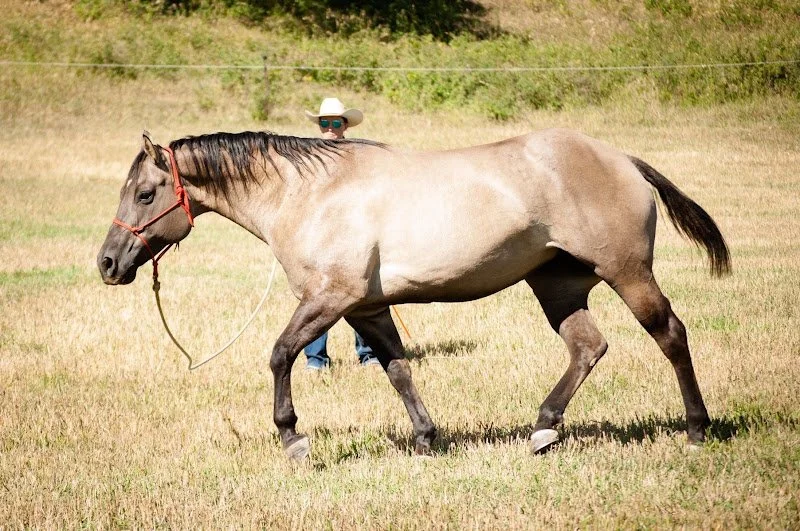
Kristi circling Vannah
3. Time Turns Understanding Into Reliability
The third ingredient is the one no program, instructor, or piece of equipment can replace: time.
Training and learning require repetition. Both the horse and the human need enough opportunities for new responses to become familiar, and eventually reliable. A good session can produce an important breakthrough, but one good session does not create a dependable skill. We have to return to it often enough that neither of us is starting over each time.
In my experience, three training days per week is the bare minimum for satisfying progress. That does not mean every session must be long, physically demanding, or perfect. It means the conversation needs enough continuity to keep developing. When we work together less often, more of each session may be spent recovering what faded between sessions. Backsliding is not defiance, and it is not proof that the horse cannot learn. It is often the predictable result of too little repetition.
I understand why this part is difficult. Life is full. Weather interferes. Our bodies hurt. Horses have off days, and so do we. There are legitimate seasons when maintenance is the best we can do. But we need to be honest about the difference between a temporary limitation and a training plan.
If we want different results, we have to create enough opportunities for those results to develop. Wanting progress while training only occasionally places an unfair burden on each individual session. It can also make us feel discouraged because our expectations are based on the size of our goals rather than the amount of practice supporting them.
Being proactive does not mean forcing progress or drilling our horses. It means deciding what matters, preparing the skills that make success possible, and showing up with enough consistency for learning to take root.
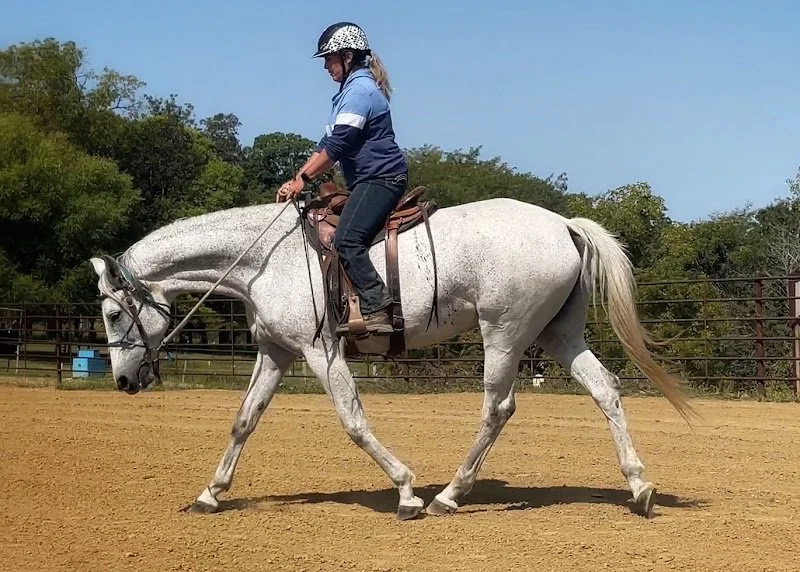
Kristi riding her mare Gina
Putting the Three Together
Goals tell us where we are going. Strategies help us respond intelligently when the path becomes difficult. Time allows the learning to become stable enough to travel with us into the real world.
I have experienced wonderful moments with my mares that felt almost effortless: a connected liberty session, a soft ride, a response that seemed to come from a thought. But those moments were not accidents, and they were not created in that single session. They were built from many ordinary days of practicing, listening, adjusting, and trying again.
That is the less glamorous truth about progress with horses. The visible result may happen in a moment, but the foundation is created over time.
If you feel stuck, look honestly at all three ingredients. Do you have specific goals that are small enough to guide today’s session? Do you have strategies for restoring the qualities that disappear when the work becomes more difficult? And are you giving yourself and your horse enough consistent time to learn?
We do not need to rush. We do, however, need to participate in the process. Our horses cannot build the partnership alone. When we bring clear goals, useful strategies, and consistent time to the relationship, we give both the horse and ourselves a much better chance to succeed.