A thoughtful, progressive framework for creating a horse who does not need reins for control.
Bridleless riding is not about removing equipment. It is about removing dependence on equipment.
A horse who goes bridleless safely and beautifully is a horse who understands your language, trusts your leadership, and is physically strong enough to carry you in balance. The bridle becomes a refinement tool, not a control device. The goal is never the removal of the bridle; the goal is developing a horse who does not need it.
This progression rests on a foundation of:
Connection
Relaxation
Responsiveness
Confidence
Impulsion
Flexion
Without these, bridleless work is either dangerous or unfair. With them, it becomes a natural extension of your partnership.
Step 1: Your Horse Is Attracted to You
Connection begins before you ever swing a leg over.
Indicators of readiness:
Your horse seeks you out rather than avoiding you.
They stay near you at liberty or on a loose line by choice.
They come toward you—not away—when uncertain.
How to cultivate this:
Spend unstructured time: grazing, scratching, walking.
Release pressure generously and honestly.
Create predictability and emotional safety.
A horse who wants to be near you is far easier to guide without equipment.
Step 2: Harmony With You on the Ground in All Gaits
If you cannot achieve harmony beside your horse, you will not find it on their back.
Indicators of readiness:
The horse matches your rhythm and energy at the walk, trot, and canter.
They can brighten and settle without tension.
Gait transitions are smooth rather than explosive or dull.
This is where you begin riding with your nervous system, not your hands.
Step 3: Soft Yields of Forehand and Hindquarters
A horse must be physically “rearrangeable” before they can be safely guided without reins.
Indicators of readiness:
A light touch moves the shoulders.
A light touch moves the hindquarters.
Yields are relaxed, rhythmic, and emotionally neutral.
These yields become the foundation of your steering and braking later on.
Step 4: Good Posture and Impulsion on the Circle
Bridleless riding depends on a horse who can carry itself in balance.
Indicators of readiness:
A long, soft topline—not hollow or inverted.
The inside hind stepping under the body.
The ability to maintain gait without nagging.
Balanced up and down transitions.
This is athletic conditioning, not desensitization.
Step 5: Standing for Grooming and Saddling Without Tying
A horse who must be restrained is not emotionally ready for bridleless work.
Indicators of readiness:
They stand quietly on a loose line or at liberty.
They stay mentally available through grooming and saddling.
They show no signs of pain or saddle-related brace.
Saddle fit matters profoundly—no horse can be bridleless if they are armored against discomfort.
Step 6: Eager Acceptance of the Bridle
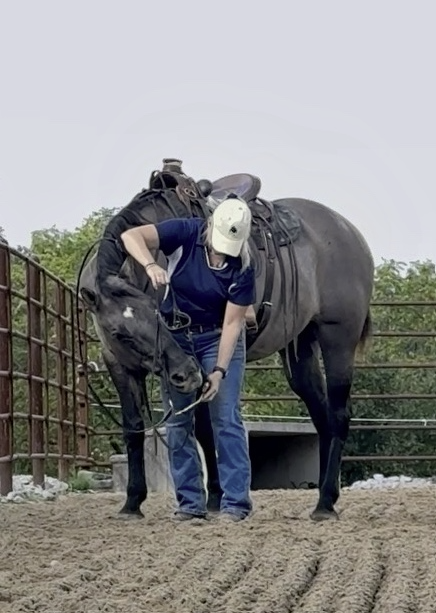
Vannah seeking the bridle with Kristi
The best bridleless horses are the ones who like the bridle.
Indicators of readiness:
They lower their head or open their mouth willingly.
They carry the bit softly, without tension or fussing.
Under saddle, the reins refine your seat rather than override it.
A horse who accepts the bridle calmly is telling you they trust your use of pressure.
Step 7: Gladly Picking You Up at the Mounting Block
Mounted work begins with consent and emotional readiness.
Indicators of readiness:
The horse brings their body to the block willingly.
They stand quietly while you mount and organize yourself.
You do not need reins to keep them in position.
This is the first bridleless moment of every ride.
Step 8: Go With Your Tailbone, Slow With Your Bellybutton
Your core becomes the directional and energetic center of the ride.
How it works:
Go:
Bring your tailbone forward and up, like initiating motion on a swing. Your seat follows the movement with freedom, inviting the horse forward.
Slow:
Draw your bellybutton gently toward your spine, toning your core. This organizes your balance and signals your horse to rebalance and slow.
Breath:
Breath in—with joy—for “go.”
Breath out—with softness—for “slow.”
Indicators of readiness:
The horse responds before you reach for the reins.
Forward does not feel rushed; slow does not feel resistant.
This step is essential—bridleless riding depends more on your core than your legs or hands.
Step 9: Steering From Your Legs Without Aversion
Legs must guide, not drive.
Inside leg first:
Inside-leg steering builds relaxation, bend, and a lifted topline. It is the beginning of true directional conversation.
Outside leg later:
Outside-leg steering adds power and straightness after relaxation and bend are well established.
Indicators of readiness:
The horse yields to your inside leg calmly in all gaits.
You can guide the arc of the body without rein corrections.
The legs shape the posture rather than push the horse away.
Leg steering is what frees you from the reins.
Step 10: Relaxation, Posture, and Steady Rhythm in All Gaits
This is the final checkpoint before bridleless attempts.
Indicators of readiness:
The horse maintains a consistent rhythm across walk, trot, and canter.
Transitions are balanced, not braced.
You can direct nose, shoulders, ribs, and hindquarters with your seat and legs.
The horse stays emotionally available and physically organized.
When a horse can do this reliably, you are almost bridleless already.
Putting It All Together
Begin bridleless work:
In an enclosed, familiar space.
With the bridle on but reins loose or draped over the neck.
Using a neck rope as an intermediate step with the bridle on.
Removing the bridle only when you are confident you will not need it.
Bridleless riding is never a stunt. It is a celebration of clarity, emotional maturity, and shared responsibility.
Final Thoughts
A horse does not owe us bridleless riding.
But they may offer it.
When the relationship is strong, the communication is subtle, and the physical preparation is correct, bridleless riding becomes simply another expression of unity. Whether you ever remove the bridle is irrelevant—the real question is whether your horse feels better, safer, and more understood because of the work you do together.
Bridleless riding is a possibility, not a requirement. Harmony is the true goal.