Relaxation and Healthy Posture: The Foundation of Autotelic Horsemanship
Autotelic horsemanship is rooted in a simple but often overlooked truth: if a horse does not feel good in her body while doing what we ask, harmony does not exist. We may see compliance, obedience, or even performance, but without comfort and relaxation, the experience is not mutually rewarding. And without that, the conversation is incomplete.
Most horse lovers genuinely care about their horse’s experience. The challenge is that comfort, posture, and relaxation are not always obvious, especially when a horse has learned to compensate, endure, or mask discomfort. True harmony requires us to look beyond behavior and ask a deeper question: How does this feel for the horse?
What Autotelic Horsemanship Really Means
The word autotelic refers to an activity that is rewarding in and of itself. In horsemanship, this means the interaction is inherently pleasing to both horse and human, not just tolerated by one party for the sake of the other.
A horse that moves with relaxation, balance, and healthy posture is far more likely to find the work intrinsically rewarding. A horse that braces, rushes, shuts down, or compensates physically may still “do the job,” but the experience is not autotelic. It is transactional.
Autotelic horsemanship asks us to prioritize the horse’s internal experience, not just the external result.
Relaxation Is Not Optional
Relaxation is not laziness, and it is not the absence of energy. In biomechanical and neurological terms, relaxation allows for efficient movement, coordinated muscle recruitment, and adaptive balance. Tension interferes with proprioception, breathing, and posture.
When a horse is relaxed:
Movement becomes fluid rather than rigid
Balance improves without force
Posture can organize itself naturally
Learning accelerates
A tense horse may still respond, but that response often relies on compensatory patterns that, over time, lead to discomfort, resistance, or injury.
Healthy Posture Is an Act of Compassion
Good posture is not about creating a “frame” or a picture. It is about supporting the horse’s skeletal and muscular system so movement feels sustainable and safe.
Healthy posture allows:
The spine to move freely
The ribcage to lift and swing
The pelvis to organize without strain
The limbs to land with reduced concussion
When posture is poor, the horse must compensate. Compensation always has a cost. Over time, that cost shows up as soreness, behavioral resistance, loss of willingness, or chronic soundness issues.
Encouraging good posture is one of the most compassionate things we can do for our horses.
Care for the Whole Horse
Posture and relaxation do not exist in isolation. They are influenced by every aspect of the horse’s care.
Nutrition affects muscle tone, recovery, and nervous system regulation.
Medical care ensures pain is not being mistaken for attitude.
Hoof care influences balance from the ground up.
Behavioral care shapes how safe a horse feels expressing feedback.
A horse cannot relax into healthy posture if her basic needs are not being met. Harmony requires stewardship.
Saddle Fit and Rider Fitness Matter
Even the most thoughtful training approach will fall apart if the equipment or the rider consistently compromises the horse’s body.
A poorly fitting saddle can restrict the shoulder, compress the spine, or create pressure points that force compensatory movement. Likewise, a rider who lacks balance, strength, or body awareness may unintentionally create a state of constant correction for the horse.
Autotelic horsemanship requires riders to take responsibility for their own athleticism. We do not need to be perfect, but we do need to be fit enough to be neutral, coordinated enough to be clear, and aware enough to notice when we are asking the horse to carry our dysfunction.
Harmony Is Felt, Not Forced
When a horse feels good in her body, relaxation becomes accessible. When relaxation is present, communication becomes subtle. When communication is subtle, partnership becomes possible.
This is not about perfection or rigid ideals. It is about curiosity, accountability, and care. It is about noticing when something feels off and being willing to adjust rather than push through.
Autotelic horsemanship invites us to measure success not by how much we can ask for, but by how good it feels for the horse to say yes.
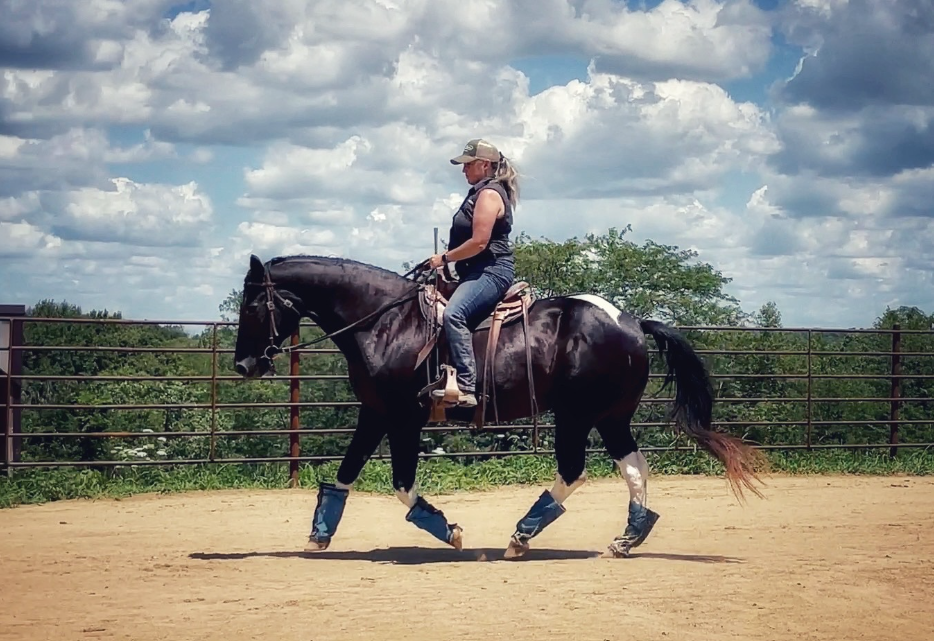
Kristi cantering her mare, Maxi
Final Thought
If we care about our horse’s experience, and most of us do, then comfort must be a priority rather than an afterthought. Relaxation and healthy posture are not advanced concepts reserved for elite horses. They are the foundation of ethical, effective, and joyful horsemanship.
Harmony is not something we demand. It is something we create by ensuring our horses feel good doing life with us.